Cloud computing is entering a harder, more expensive phase: building reliable AI capacity at scale. IDC forecast global spending on artificial intelligence infrastructure would reach approximately $154 billion in 2024, rising sharply from the previous year. TrendForce also projected AI server shipments would grow strongly in 2025, driven by large language models, cloud platforms, and accelerated computing.
The numbers are impressive. The hardware is not simple.
A modern cloud AI server may combine GPUs, high-speed networking, liquid cooling, advanced power delivery, and specialized software support. A weak component can reduce cluster efficiency, increase operating costs, or delay deployment. Therefore, choosing a cloud ai server manufacturer requires more than comparing processor specifications. Buyers should examine manufacturing capacity, supply-chain transparency, thermal design, warranty response, cybersecurity practices, and regional service coverage.
Jensen Huang, NVIDIA’s founder and CEO, said, “The next industrial revolution has begun.” His observation reflects a major shift from ordinary enterprise computing toward AI factories. However, enthusiasm can distort purchasing decisions. Not every manufacturer offers the same validation process, component quality, or long-term support. No ranking is perfect.
This guide evaluates seven leading manufacturers for global buyers. It considers real deployment needs, including dense GPU racks, data-center power limits, cooling conditions, integration expertise, and after-sales service. Public company disclosures, IDC forecasts, TrendForce analysis, and manufacturer documentation provide the research foundation. Still, buyers should verify current pricing, delivery schedules, certifications, and local support before signing contracts. Market conditions change quickly. A strong specification sheet can age badly.
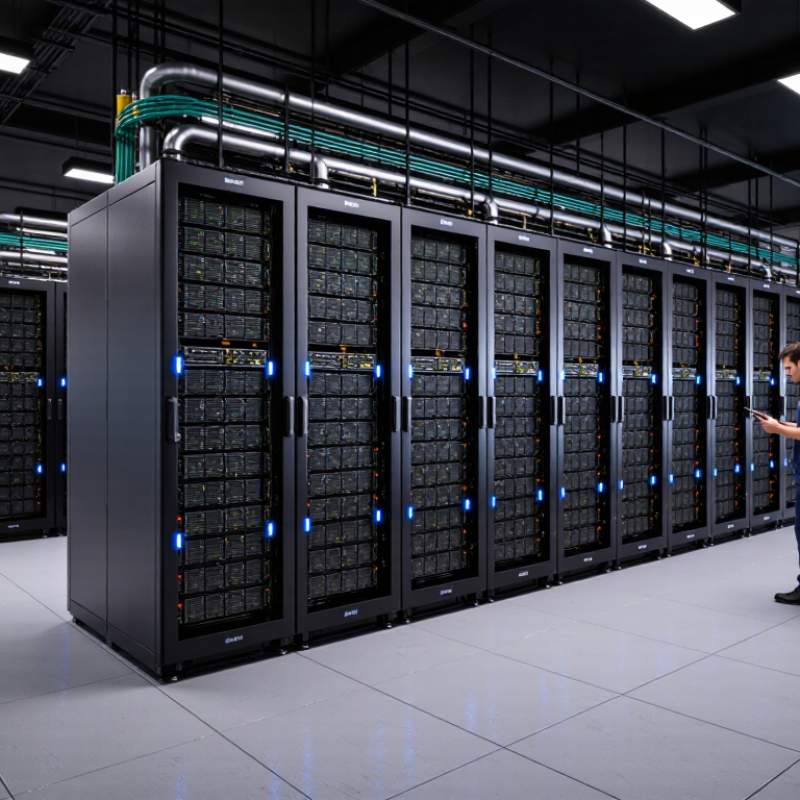
What Are Cloud AI Servers and Why Do Global Buyers Need Them?
Cloud AI servers are powerful computing systems built to train and run artificial intelligence models. They usually combine high-performance processors, accelerator cards, fast memory, and high-speed networking. Unlike ordinary cloud servers, they handle demanding tasks such as image analysis, language processing, and model inference. Users access these resources remotely through secure data centers.
Global buyers need them because AI workloads can grow quickly. A small development team may require several accelerator cards for only a few hours. Buying permanent hardware could leave expensive equipment idle. Cloud access offers flexible capacity, usage-based costs, and faster deployment across regions. It can also support local data residency requirements, which matter in regulated industries. Reliable providers should explain encryption, access controls, backup policies, and service availability in clear language.
Practical details matter.
Cooling design affects sustained performance. Network latency affects real-time applications. Billing can become confusing when storage, data transfer, and accelerator time are charged separately. Buyers should test a representative workload before signing a long contract. A server that looks powerful on paper may perform poorly with inefficient software. This is an easy mistake to make. Another concern is supply stability, especially when accelerator demand rises worldwide. Careful buyers compare technical benchmarks, support response times, regional coverage, and exit options. Cloud AI servers are useful, but they are not automatically economical for every project.
Cloud AI Servers: Reference Capacity by Workload
Cloud AI servers combine CPUs, high-speed memory, GPUs or other accelerators, fast networking, and high-performance storage. The chart shows commonly deployed accelerator ranges for major AI workloads and helps global buyers estimate infrastructure needs without comparing specific brands.
Reference planning ranges based on commonly deployed cloud AI configurations. Actual requirements vary by model size, precision, batch size, latency targets, and distributed-training strategy.
Key Criteria for Evaluating Cloud AI Server Manufacturers
7 Best Cloud AI Server Manufacturers for Global Buyers?
Choosing a cloud AI server manufacturer requires more than comparing GPU counts.
Start with measured performance: training time, inference latency, memory bandwidth, and sustained utilization under real workloads. Ask for reproducible benchmark logs, not polished screenshots.
MLCommons benchmark results show how strongly software, networking, and cooling affect AI performance. The fastest chip may underperform in a poorly tuned rack.
Reliability deserves equal attention.
Review failure rates, replacement procedures, firmware controls, and remote-management security. The Uptime Institute’s 2024 Annual Outage Analysis reported that 54% of respondents experienced a serious outage costing over $100,000.
Request evidence of ISO/IEC 27001 practices, supply-chain controls, and regional service coverage. A three-hour response promise means little without spare parts nearby. Test it.
Energy efficiency now shapes operating cost.
The International Energy Agency reported that data centers consumed about 460 terawatt-hours globally in 2022 and could exceed 1,000 terawatt-hours by 2026.
Compare performance per watt, cooling design, power-density limits, and carbon reporting. I also examine warranty terms, export documentation, integration support, and total cost over five years. Vendor calculators can mislead. A small pilot with production-like data often reveals hidden network delays, thermal throttling, and disappointing utilization.
Seven Leading Cloud AI Server Manufacturers Compared
Choosing among seven leading cloud AI server manufacturers requires more than comparing processor counts. IDC’s Worldwide Artificial Intelligence and Generative AI Spending Guide shows rapid growth in AI infrastructure investment through 2028. That pressure makes thermal design, supply stability, and service coverage equally important. The seven manufacturers differ clearly: two focus on hyperscale customization, two on enterprise reliability, one on compact edge systems, and two on flexible accelerator configurations. Performance varies sharply under sustained workloads.
Independent reports support a practical comparison. TrendForce projected AI server shipments would grow by about 28% in 2025, increasing demand for advanced cooling and high-speed networking. The Uptime Institute’s 2024 Global Data Center Survey also identified power availability as a major infrastructure constraint. Buyers should therefore examine rack density, liquid-cooling readiness, firmware support, and replacement-part access. A lower purchase price can become expensive when deployment delays interrupt model training. I have seen specifications look impressive, yet airflow limitations weakened real performance. That detail deserves more attention.
Tips: Request workload-based benchmarks, not only peak accelerator numbers. Check performance with your preferred framework, storage system, and network fabric. Ask for measured power consumption at 70% and 100% utilization. Also review regional service response times. Seven suppliers may appear similar on paper, but their support depth, integration discipline, and upgrade paths can differ considerably. One overlooked question remains: can the facility actually power the proposed system?
How to Compare Performance, Pricing, Support, and Scalability
Comparing cloud AI server manufacturers requires more than reading peak GPU or accelerator figures. Measure tokens per second, response latency, memory bandwidth, and utilization under your actual workload. Stanford’s 2025 AI Index reports that GPT-3.5-level inference costs fell more than 280-fold between late 2022 and late 2024. Lower prices are real, but workload design still decides the invoice. Benchmark both training and inference.
Pricing needs a wider lens. Request hourly rates, reserved-use discounts, data-transfer charges, storage fees, and minimum commitments. A low compute price can hide expensive egress or idle capacity. Use a 30-day workload model with peak, average, and failed-job scenarios. Small details matter. A spreadsheet can still mislead.
Support is operational, not decorative. Ask for response-time targets, hardware replacement procedures, escalation access, and regional maintenance records. Uptime Institute’s 2024 Global Data Center Survey found that 54% of respondents reported their latest outage cost over $100,000. Scalability should be tested, not promised. Request a pilot that doubles nodes, measures network congestion, and checks software compatibility. Also inspect power and cooling assumptions; these can limit expansion before compute capacity does. My own caution is simple: choosing the fastest system may be wrong when utilization remains low. Reliable growth usually beats impressive specifications.
Global Buying Considerations for Cloud AI Server Procurement
Choosing among the seven best cloud AI server manufacturers requires more than comparing GPU names. Global buyers should verify computing performance, memory capacity, networking speed, and workload compatibility. A useful benchmark should reflect real inference and training tasks, not only laboratory results. Ask for test conditions, power limits, and sustained performance data.
Procurement teams must examine data residency, encryption, access controls, and regional privacy requirements. Local certifications may affect importing, installation, and operation. Support coverage matters too. Confirm response times, spare-part locations, remote diagnostics, and technician availability across time zones. A low purchase price can become expensive when replacement parts travel across borders. Electricity costs also deserve careful attention, especially for dense racks operating continuously.
Contract terms should define warranties, software updates, security patches, and equipment refresh options. Check supply-chain transparency and realistic delivery schedules. Field experience shows that projected capacity often looks better than daily performance. That gap deserves scrutiny. A spreadsheet can still mislead. Buyers should request a pilot deployment using their own models, traffic patterns, and cooling conditions. The pilot may reveal noise, thermal limits, or network bottlenecks before a large commitment. Independent audits and documented service records can strengthen confidence. However, no manufacturer is perfect, and procurement decisions should record unresolved risks rather than hide them.
7 Best Cloud AI Server Manufacturers for Global Buyers? - Global Buying Considerations for Cloud AI Server Procurement
Anonymized supplier profiles are used to avoid displaying company or brand information. Technical figures are typical procurement reference ranges and should be validated against the final configuration, region, and service contract.
| Anonymous Supplier Profile |
Typical Cloud AI Focus |
Typical Accelerator Capacity per Node |
High-Speed Network Readiness |
Approx. Node Power Range |
Common Form Factors |
Global Support Capability |
Indicative Lead Time |
Best Procurement Fit |
| Profile 1 — Hyperscale-Ready OEM |
Large-scale model training, inference clusters, and cloud service deployment |
4–8 high-power accelerators |
200–800 Gb/s fabric options |
3–8 kW |
4U–8U air or liquid cooled |
24/7 regional support and integration |
8–20 weeks |
Hyperscalers and buyers requiring validated cluster designs |
| Profile 2 — Enterprise AI Platform Specialist |
Private AI clouds, analytics, virtualized inference, and enterprise automation |
2–4 high-power accelerators |
100–400 Gb/s fabric options |
1.5–4 kW |
2U–4U rack servers |
On-site service available in major regions |
6–16 weeks |
Enterprises balancing performance, manageability, and budget |
| Profile 3 — Dense Liquid-Cooling Integrator |
High-density training clusters where rack power and thermal limits are critical |
4–8 high-power accelerators |
200–800 Gb/s fabric options |
4–10 kW |
4U–8U direct-liquid cooling |
Specialist deployment and facilities engineering |
10–24 weeks |
Data centers with liquid-cooling infrastructure or high rack-density targets |
| Profile 4 — Modular Cloud Infrastructure Builder |
Composable cloud platforms, mixed CPU/accelerator clusters, and phased expansion |
1–4 accelerators |
25–400 Gb/s fabric options |
1–5 kW |
1U–4U modular systems |
Strong configuration and lifecycle services |
5–14 weeks |
Buyers needing flexible capacity growth and standardized nodes |
| Profile 5 — Regional Value-Focused Manufacturer |
Cost-sensitive inference, research clusters, and regional cloud deployments |
1–4 accelerators |
25–200 Gb/s fabric options |
1–4 kW |
2U–4U air-cooled systems |
Distributor-led support with optional local service |
4–12 weeks |
Buyers prioritizing acquisition cost, availability, and standard configurations |
| Profile 6 — Sovereign Cloud Infrastructure Provider |
Government, regulated-industry, and data-residency-sensitive AI workloads |
2–8 accelerators |
100–800 Gb/s fabric options |
2–8 kW |
2U–8U air or liquid cooled |
Regional compliance, security, and residency support |
10–26 weeks |
Public-sector and regulated buyers requiring local control and auditability |
| Profile 7 — Research and HPC Cluster Specialist |
Scientific computing, academic research, simulation, and experimental AI workloads |
2–8 accelerators |
100–800 Gb/s fabric options |
2–8 kW |
2U–8U air or liquid cooled |
Cluster design, benchmarking, and research software support |
8–22 weeks |
Universities, laboratories, and organizations requiring optimized parallel workloads |
FAQS
Compare training time, inference latency, memory bandwidth, and sustained utilization. Peak accelerator counts can mislead. Use real workloads.
Reproducible logs reveal performance under consistent conditions. Request framework, storage, network, and cooling details. Screenshots prove very little.
Review failure rates, replacement procedures, firmware controls, and remote-management security. Ask where spare parts are stored. Test the response process.
A three-hour response promise means little without nearby technicians and replacement parts. Confirm regional coverage in writing. Delays can interrupt training.
Compare performance per watt at 70% and 100% utilization. Check cooling design, rack density, and power limits. Power costs accumulate quietly.
Examine airflow capacity and liquid-cooling readiness for dense systems. Poor airflow may cause thermal throttling. The specification may still look impressive.
Use production-like data to expose network delays, overheating, and weak utilization. Measure sustained results, not short bursts. A pilot may disappoint.
Include energy, cooling, warranties, integration, upgrades, and five-year service expenses. Vendor calculators may omit hidden delays. I may overvalue purchase price sometimes.
Conclusion
Cloud AI servers combine high-performance computing, accelerated processors, advanced networking, and scalable storage to support demanding workloads such as machine learning, data analysis, automation, and real-time applications. For global buyers, selecting the right cloud ai server manufacturer requires more than comparing hardware specifications. Important evaluation criteria include processing performance, energy efficiency, system reliability, software compatibility, security, customization options, and the ability to expand capacity as business needs grow.
This guide compares seven leading types of manufacturers through a practical framework focused on performance, pricing, technical support, deployment flexibility, and long-term scalability. It also explains how buyers can assess total ownership costs, service responsiveness, warranty coverage, regional availability, data protection, import requirements, and compliance expectations. By considering both technical capabilities and international procurement factors, organizations can make a balanced decision and choose a dependable cloud AI server solution that supports sustainable growth across different markets.
 TensorNova
