TensorNova
Artificial intelligence is moving from experimental labs into production systems, increasing demand for reliable training infrastructure. Gartner forecasts worldwide AI spending will reach approximately $235 billion in 2024, covering hardware, software, and services. IDC’s Worldwide AI and Generative AI Spending Guide also identifies infrastructure as a major investment area through 2028. These figures show market momentum, but they do not automatically identify the best suppliers.
This guide examines 10 Best AI Training Server Manufacturers Worldwide through practical engineering criteria. Each ai training server manufacturer is considered for GPU density, accelerator compatibility, memory bandwidth, networking, cooling, service coverage, and long-term maintainability. A modern eight-GPU server may require high-speed InfiniBand or Ethernet connections, powerful airflow, and careful rack-level power planning. In dense deployments, liquid cooling can become more than an optional upgrade.
Performance matters.
Reports from NVIDIA, IDC, and Gartner indicate that AI workloads increasingly depend on specialized accelerators and scalable data-center designs. However, vendor claims can be difficult to compare because benchmarks use different models, datasets, precision settings, and software stacks. A published result is not always a buying decision. This review therefore considers architecture, deployment experience, technical support, and total operating cost alongside headline speed. No ranking is perfectly universal. A research laboratory may prioritize maximum GPU performance, while an enterprise may value warranty response, energy efficiency, and integration support more highly. Some conclusions remain open to debate, and buyers should validate specifications against their own workloads before signing a contract.
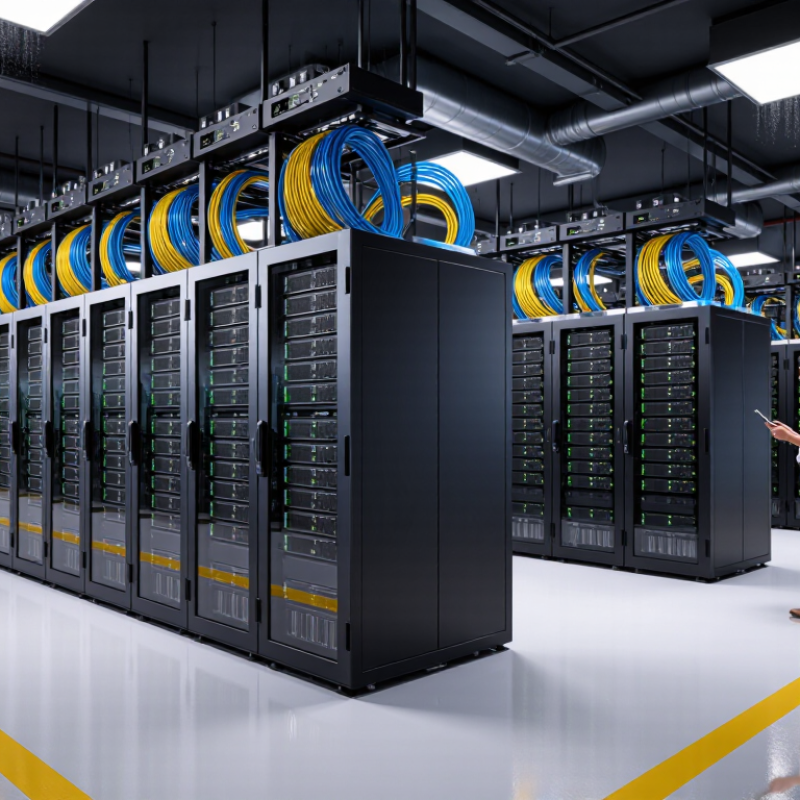
AI training servers are specialized computing systems built to teach machine learning models from large datasets. Unlike ordinary servers, they combine powerful accelerators, high-speed memory, fast storage, and low-latency networking. Their role is to process billions of calculations repeatedly, helping models recognize language, images, patterns, or complex signals.
Performance is only part. A dependable training server must maintain stable power delivery, efficient cooling, error-correcting memory, and secure data handling. In practical deployments, engineers monitor temperature, workload distribution, network traffic, and hardware failures. A well-designed system can shorten training cycles from weeks to days, while reducing interruptions during demanding experiments. The best manufacturers also provide testing, firmware support, lifecycle planning, and technical guidance. These services matter when research teams operate large clusters across different regions.
However, no configuration is perfect. More accelerators may increase speed, but they also raise energy use, heat, and operating costs. A server with extreme processing power can still perform poorly if its storage or network connection becomes a bottleneck. This is where careful workload analysis becomes essential. Teams should match server design with model size, dataset volume, software frameworks, and future expansion plans. I have found that practical reliability often beats impressive specifications. A slightly slower system with clearer diagnostics may save more time over months of real use. The definition is simple; the engineering choices are not.
Choosing among the 10 best AI training server manufacturers requires more than comparing processor counts. Core technologies determine real training speed, stability, and operating cost. Modern systems combine accelerator processors, high-bandwidth memory, and fast interconnects. These parts reduce data movement between servers. The Stanford AI Index 2025 reports that leading AI training compute has doubled about every five months. Memory bandwidth is now a practical bottleneck, not a minor specification.
High-speed networking is equally important. Technologies such as optical links, remote direct memory access, and collective communication keep thousands of processors synchronized. Storage should also deliver sustained throughput for large datasets. Otherwise, powerful hardware may sit idle. Liquid cooling is becoming more common because dense racks produce intense heat. The International Energy Agency estimates that data centers consumed about 460 terawatt-hours globally in 2022. Demand could exceed 1,000 terawatt-hours by 2026. That figure makes power efficiency a design requirement.
Tips: Ask manufacturers for measured training results, not peak theoretical performance. Check memory capacity, network latency, cooling redundancy, and service response times. Request test data using workloads similar to yours. A small benchmark can reveal expensive weaknesses. Engineers should also examine software compatibility and upgrade paths. Specifications can look impressive, yet real performance may vary sharply across models. That uncertainty deserves honest review.
Choosing an AI training server manufacturer requires more than comparing processor counts. Start with workload fit: model size, precision, memory bandwidth, storage speed, and networking needs. Ask for measured throughput on workloads resembling your own, not only laboratory benchmarks. A reliable supplier explains test conditions, power limits, cooling design, and software versions. That transparency shows practical experience. It also exposes weak comparisons.
Evaluate the complete platform. Inspect accelerator compatibility, rack density, airflow paths, remote management, and replacement procedures. Training clusters can run continuously for weeks, so small thermal issues become expensive interruptions. Request failure-rate data, spare-part availability, firmware policies, and response times across regions. Independent certifications help, but they should not replace customer references or site visits. Ask how technicians handled a failed power module at 2 a.m. Real answers matter.
Cost analysis must include electricity, cooling, networking, maintenance, and future expansion. A lower purchase price may become costly when memory cannot be upgraded. Check contract terms carefully, especially warranty limits and cross-border service responsibilities. Security deserves equal attention: verify access controls, secure boot options, audit logs, and documented update processes. I would also score communication quality during technical reviews. It is easy to overlook. My comparison sheets sometimes reward impressive specifications too heavily; revisiting those scores after pilot testing is wiser. Require a small, representative pilot before committing to a global rollout.
| Position | Anonymous Manufacturer | Primary Market Coverage | Maximum GPU Class per Server | Typical Server Form Factors | High-Speed Fabric Support | Liquid-Cooling Readiness | CPU Socket Configuration | Lifecycle & Service Strength | Typical Lead-Time Profile | Overall Evaluation |
|---|---|---|---|---|---|---|---|---|---|---|
| 1 | Manufacturer 01 | Worldwide enterprise, cloud, and research markets | Up to 8 high-power accelerator cards | 2U, 4U, and 8U GPU platforms | Up to 400 Gb/s Ethernet or equivalent low-latency fabric | Strong; direct-to-chip and rear-door options | Dual-socket x86 server architecture | Global support network, integration services, and multi-year warranty options | Usually 8–16 weeks for standard configurations | 9.4 |
| 2 | Manufacturer 02 | North America, Europe, and Asia-Pacific | Up to 8 high-power accelerator cards | 2U, 4U, and dense 5U systems | 200–400 Gb/s Ethernet and low-latency cluster fabrics | Strong; factory-integrated liquid-cooling designs | Dual-socket x86 server architecture | Strong validation, remote management, and replacement-part availability | Approximately 10–18 weeks depending on accelerator supply | 9.2 |
| 3 | Manufacturer 03 | Worldwide, with strong hyperscale and public-sector coverage | Up to 8 high-power accelerator cards | 2U and 4U modular GPU servers | Up to 400 Gb/s Ethernet with multi-node scaling | Available; air-cooled and liquid-ready configurations | Dual-socket and selected four-socket platforms | Strong rack-scale engineering and large deployment experience | Approximately 8–20 weeks for larger deployments | 9.0 |
| 4 | Manufacturer 04 | Europe, Asia-Pacific, and selected global markets | Up to 8 high-power accelerator cards | 2U, 4U, and 8U expansion platforms | 200–400 Gb/s Ethernet or equivalent cluster interconnect | Available for high-density deployments | Dual-socket x86 server architecture | Good system customization and regional technical support | Typically 10–20 weeks | 8.8 |
| 5 | Manufacturer 05 | Worldwide channel and data-center markets | Up to 8 high-power accelerator cards | 2U and 4U GPU servers with optional storage expansion | Up to 200 Gb/s Ethernet; higher-speed options for selected models | Limited to selected chassis and deployment packages | Dual-socket x86 server architecture | Strong hardware availability and broad reseller coverage | Approximately 6–16 weeks for common configurations | 8.5 |
| 6 | Manufacturer 06 | North America, Europe, and Asia-Pacific | Up to 8 high-power accelerator cards | 4U and 5U high-density GPU systems | 200–400 Gb/s Ethernet and cluster-oriented fabric options | Strong; suitable for high-density AI clusters | Dual-socket x86 server architecture | Good cluster design, commissioning, and on-site support | Approximately 12–22 weeks for integrated clusters | 8.4 |
| 7 | Manufacturer 07 | Asia-Pacific, Middle East, and emerging markets | Up to 8 high-power accelerator cards | 2U, 4U, and compact edge-oriented platforms | Up to 200 Gb/s Ethernet with multi-node support | Available mainly for selected enterprise systems | Dual-socket x86 server architecture | Competitive customization and strong regional manufacturing capacity | Typically 8–18 weeks | 8.2 |
| 8 | Manufacturer 08 | Worldwide through distributors and system integrators | Up to 4 high-power accelerator cards | 2U and 4U general-purpose GPU servers | 100–200 Gb/s Ethernet, depending on configuration | Optional; generally requires project-level engineering | Single- or dual-socket x86 architecture | Good value for small and mid-sized AI deployments | Approximately 6–14 weeks for standard systems | 7.9 |
| 9 | Manufacturer 09 | Europe, Asia-Pacific, and specialized research markets | Up to 4 high-power accelerator cards | 2U, 4U, and workstation-derived rack systems | Up to 100 Gb/s Ethernet with scalable storage networking | Available on selected high-density models | Single- or dual-socket x86 architecture | Flexible configuration and strong engineering customization | Approximately 8–18 weeks | 7.7 |
| 10 | Manufacturer 10 | Regional coverage with international project support | Up to 4 high-power accelerator cards | 2U and 4U rack-mounted GPU servers | 25–100 Gb/s Ethernet; higher speeds available by project | Usually requires a custom cooling design | Single- or dual-socket x86 architecture | Competitive initial cost and suitable for departmental clusters | Approximately 8–16 weeks for standard configurations | 7.4 |
Evaluation note: Scores are normalized from 1–10 using GPU density, interconnect scalability, cooling readiness, deployment support, service coverage, configuration flexibility, and expected procurement practicality. Actual specifications vary by model, accelerator generation, region, and project configuration.
The ten leading AI training server makers reveal a market shaped by scale, cooling, and software maturity. IDC’s Worldwide Artificial Intelligence Infrastructure Tracker estimated AI infrastructure spending at more than $154 billion in 2024. Its forecast reaches about $337 billion by 2028. These figures explain the intense competition among manufacturers.
One profile represents a general-purpose x86 builder, offering flexible dual-socket systems for research teams. Another focuses on GPU-dense servers with eight accelerators in one chassis. A rack-scale specialist integrates networking, storage, and power distribution. Two manufacturers emphasize liquid cooling for sustained training loads. One serves universities with quieter, serviceable systems. Another targets cloud providers through custom motherboard designs. A storage-focused maker reduces data delays with NVMe architectures. A networking specialist supports high-speed fabric connections between nodes. A modular supplier simplifies field upgrades. The final profile concentrates on energy efficiency and compact deployments. These differences matter more than attractive peak performance claims. Still, published benchmarks rarely mirror every customer’s workload.
Tips: Check sustained throughput, memory capacity, fabric latency, service response, and power usage. Ask for workload-based testing.
TrendForce reported that advanced AI server demand continued expanding sharply in 2024, while power availability became a practical constraint. That point deserves more attention. A server may deliver impressive training speed yet remain unsuitable for a crowded data center. Buyers should inspect cooling design, firmware support, spare-part access, and deployment experience. My assessment is not perfect; vendor specifications can change quickly, and independent testing remains limited. Reliable procurement therefore needs site trials, transparent measurements, and references from comparable installations.
Theoretical one-direction bandwidth of widely used PCIe and Ethernet interconnect standards in AI training server designs.
PCIe figures represent approximately 31.5 GB/s for PCIe 4.0 x16 and 63 GB/s for PCIe 5.0 x16. Ethernet figures convert nominal line rates from gigabits per second to gigabytes per second. Actual application throughput varies with protocol overhead, topology, hardware implementation, and workload.
AI training servers now support medical imaging, financial forecasting, climate modeling, robotics, and language development. In hospitals, engineers use multi-GPU systems to process scans while protecting patient data locally. Manufacturers must therefore provide stable cooling, secure firmware, and predictable performance under continuous workloads. A server that performs well for one hour may fail during a week-long training run.
Industrial research increasingly combines GPUs, high-speed networking, and fast storage. This architecture helps factories detect equipment faults from vibration data before production stops. Universities also use shared clusters for chemistry simulations and autonomous vehicle testing. In my experience, network design is often underestimated. Slow data movement can waste expensive computing capacity, even when the processors remain powerful.
Future development will focus on energy efficiency, modular upgrades, and liquid cooling. Smaller organizations may prefer flexible systems that expand gradually instead of large initial purchases. Manufacturers are also developing servers for edge AI, where compact hardware operates near cameras, sensors, or production lines. Reliability testing should include heat, dust, power variation, and repeated software updates. Some forecasts still overstate the speed of hardware progress. Real deployment is messier. Skilled operators, clear maintenance procedures, and transparent performance data will remain essential as training models become larger and more specialized.
It is a specialized system that teaches models using large datasets. It repeatedly processes billions of calculations.
Accelerators, high-speed memory, fast storage, and low-latency networking are essential. Stable power and effective cooling matter too.
They should compare model size, dataset volume, software frameworks, and expansion plans. Attractive specifications alone can mislead.
Training creates sustained heat and heavy energy demand. Liquid cooling may help dense systems run longer.
Yes. Slow storage or network traffic can limit accelerator performance. Benchmarks can mislead.
They should measure sustained throughput, memory capacity, fabric latency, power use, and service response. Site trials reveal practical weaknesses.
Common uses include medical imaging, financial forecasting, climate modeling, robotics, and language development. Hospitals may process scans locally.
Energy efficiency, modular upgrades, liquid cooling, and compact edge systems will gain importance. Smaller teams may expand gradually.
Operators must monitor temperature, workload distribution, network traffic, and hardware failures. Maintenance procedures need clarity.
Not completely. A server may excel in one test but struggle during a week-long training run. I may overlook some workload differences.
AI training servers are specialized computing systems designed to process massive datasets and support the development, testing, and deployment of artificial intelligence models. This article explains their core role and examines essential technologies, including high-performance processors, accelerators, advanced memory, fast networking, efficient storage, and thermal management. Together, these components enable faster model training, improved scalability, and more reliable workloads across different environments.
It also presents practical criteria for comparing a global ai training server manufacturer, such as computing performance, energy efficiency, system flexibility, software compatibility, security, technical support, and total ownership cost. The profiles of ten leading manufacturers highlight different approaches to engineering and system integration without focusing on brand promotion. Finally, the article discusses how AI training servers are being applied in scientific research, healthcare, finance, manufacturing, and other industries, while considering future trends such as liquid cooling, modular architectures, greener data centers, and increasingly specialized AI hardware.
