TensorNova TensorNova

How to Choose a Data Center AI Server Manufacturer?

Time:2026-09-21 Author:Sophia
0%

Choosing a data center AI server manufacturer now involves more than comparing processor names and purchase prices. AI workloads require dense GPU systems, high-speed networking, advanced cooling, and dependable software support. The International Energy Agency’s Electricity 2024 report estimates that data centers consumed about 460 terawatt-hours globally in 2022. It also projects that demand could exceed 1,000 terawatt-hours by 2026 in a high-growth scenario. Power efficiency is no longer a minor specification.

A capable supplier should explain complete system performance, not only peak FLOPS. Ask for verified results under sustained workloads, including model training, inference, storage access, and network traffic. Check GPU availability, rack power requirements, liquid-cooling options, firmware control, and replacement procedures. Uptime Institute’s Global Data Center Survey repeatedly highlights power, cooling, and operational resilience as major data center concerns. These findings make service coverage and deployment experience essential selection criteria. A low quotation may hide expensive integration work.

Independent evidence matters. Consult benchmark results, customer references, and documented service-level commitments. IDC and Dell’Oro Group research both show strong expansion in AI infrastructure demand, but market growth does not guarantee every vendor’s reliability. Some manufacturers have impressive demonstrations yet limited field support. That distinction deserves attention. The right data center ai server manufacturer should provide realistic capacity planning, transparent total-cost estimates, and measurable energy targets. Buyers should also test a pilot rack before signing a large contract. This step may feel slow, but it exposes thermal instability, driver conflicts, and maintenance delays early. No checklist is perfect. A careful review still reduces avoidable risk.
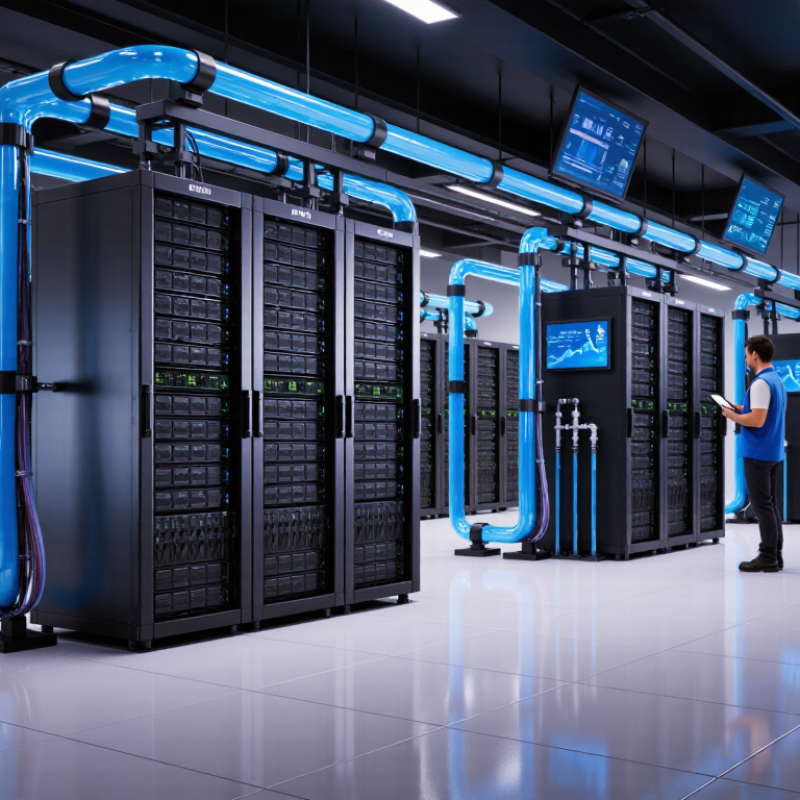
How to Choose a Data Center AI Server Manufacturer?

Define AI Workloads: NVIDIA H100 SXM GPUs Reach 700 W TDP

Choosing a data center AI server manufacturer begins with workload reality, not a glossy specification sheet. A high-end SXM accelerator can reach 700 watts of thermal design power. That figure changes the entire server design. It affects rack density, airflow, power distribution, and operating cost. Training workloads may sustain this load for hours. Short inference bursts behave differently, but they still create sharp thermal demands. Ask the manufacturer for measured data under your intended workload.

An experienced supplier should explain how its chassis handles sustained heat. Look for liquid cooling options, high static-pressure fans, and clear airflow paths. Power shelves, cabling, and voltage regulation require equal attention. A server that boots reliably may still throttle during a long training run. Request logs from stress tests, including accelerator temperature, clock stability, fan speed, and power draw. Numbers matter more than marketing language. Insist on service procedures for pumps, cold plates, filters, and replacement parts. Poor maintenance planning becomes expensive quickly.

Reliability also depends on engineering discipline. Ask whether the system passed burn-in testing at full accelerator load. Check firmware controls, remote monitoring, and alert thresholds. The manufacturer should document noise, inlet temperature limits, and maximum rack power. Do not accept vague cooling claims. I have seen impressive prototypes fail in crowded racks. That lesson still matters. A practical evaluation should use your rack, workload, and facility limits. The best supplier may not offer the highest density. It should offer predictable performance, honest constraints, and support your technicians can actually use.

Data Center AI Server Planning: Accelerator TDP by Form Factor

Accelerator thermal design power directly affects server cooling, power delivery, rack density, and operating cost. An 8-accelerator configuration using 700 W SXM modules requires approximately 5.6 kW for accelerator modules alone, before accounting for CPUs, memory, networking, storage, and cooling overhead.

Compare Vendors Using MLPerf Training Time-to-Train Results

How to Choose a Data Center AI Server Manufacturer? Compare Vendors Using MLPerf Training Time-to-Train Results

Choose an AI server manufacturer by measuring completed training time, not advertised peak FLOPS. MLPerf Training results from MLCommons report the minutes required to reach a defined accuracy target. This makes comparisons more practical for procurement teams. Review matching workloads, such as large language models, recommendation systems, and image training. A lower time-to-train can shorten project schedules and reduce cluster reservation costs. However, results depend on processor count, accelerator type, memory, networking, software versions, and dataset settings. Compare identical configurations whenever possible.

MLPerf Training v4.1 showed major performance differences between system configurations, especially when scaling across many accelerators. The report also demonstrates that communication efficiency affects real training speed. A server with strong single-node performance may lose its advantage at cluster scale. The International Energy Agency reported that data centers consumed about 460 TWh of electricity globally in 2022. Therefore, evaluate time-to-train beside energy use, cooling design, and utilization. Faster is not always better if power demand rises sharply. This is where procurement decisions become less certain.

Tips: Request complete MLPerf disclosures, including software stack, accelerator quantity, precision, and network topology. Recalculate performance using your own model and data. Treat benchmark results as evidence, not proof. A small pilot often reveals bottlenecks that published charts miss.

Verify Reliability: Tier IV Facilities Target 99.995% Availability

How to Choose a Data Center AI Server Manufacturer?

When evaluating an AI server manufacturer, verify the facility behind its infrastructure. A Tier IV data center targets 99.995% availability, allowing roughly 26 minutes of annual downtime. This figure is a design objective, not an unconditional promise. Ask for current certification, audit scope, and the date of the latest assessment. Marketing language alone proves little.

High-density AI servers place unusual demands on power and cooling systems. Look for independent power paths, fault-tolerant equipment, and maintenance procedures that avoid interrupting workloads. Liquid cooling may improve thermal control, but it also adds pumps, sensors, and possible failure points. Inspect how technicians test these systems under realistic load. Ask uncomfortable questions.

Reliability also depends on operational discipline. Request anonymized incident records, service-level terms, recovery targets, and evidence of regular disaster exercises. Check whether spare components are stored nearby and whether support engineers respond around the clock. In my experience, a polished facility tour can hide weak documentation. That should concern you.

Do not judge a manufacturer only by processor specifications or benchmark scores. Compare its monitoring tools, firmware management, maintenance windows, and escalation process. A reliable supplier explains limitations clearly, including events that its availability target does not cover. This honesty is valuable. Even a Tier IV facility can experience human error, regional disruption, or an unexpected control-system fault.

Assess Energy and TCO: Data-Center Demand May Reach 945 TWh by 2030

How to Choose a Data Center AI Server Manufacturer?

Energy performance should shape the server decision, not follow it. Goldman Sachs Research projects global data-center electricity demand could reach 945 TWh by 2030. That number changes procurement priorities. A server drawing extra power also creates more cooling demand, rack pressure, and operating expense.

Ask manufacturers for measured performance under realistic AI workloads. Request accelerator utilization, power usage effectiveness assumptions, thermal limits, and failure rates. The International Energy Agency reports that data-center electricity consumption could exceed 1,000 TWh globally by 2026. Efficiency claims need context. A peak benchmark may not represent a full production day.

Total cost of ownership needs a wider lens. Include electricity, cooling, network upgrades, maintenance, software support, and replacement cycles. The Uptime Institute’s infrastructure research repeatedly links rising rack density with greater cooling complexity. A compact server may still require costly facility changes. Watch the hidden load.

I would compare three-year and five-year scenarios, using local electricity prices and seasonal demand. Results can look surprisingly different. Do not trust a single efficiency score. Ask for independently verifiable test methods and workload details. Some projections may also be wrong; AI usage, grid constraints, and hardware progress can shift quickly. A dependable manufacturer should explain uncertainty instead of promising perfect savings.

Audit Security, Supply Capacity, Warranties, and Three-Year Support

Choosing an AI server manufacturer requires more than benchmark speed. Security, supply capacity, warranty language, and three-year support deserve equal scrutiny. Request independent audit evidence, including ISO 27001 scope, SOC 2 reports, penetration-test summaries, and secure firmware procedures. IBM’s Cost of a Data Breach Report 2024 placed the global average breach cost at 4.88 million dollars. Weak access controls can become an expensive procurement risk. Ask who receives vulnerability notices, how quickly patches arrive, and whether remote service access can be disabled.

Validate capacity with evidence, not reassuring forecasts. Review component allocation, production lead times, regional inventory, and replacement-part availability. Uptime Institute’s Annual Outage Analysis 2024 reported that 54% of surveyed outages cost more than 100,000 dollars. For AI clusters, one missing accelerator or power module can extend downtime. A strong warranty should define response times, advance replacement, labor coverage, and exclusions. The support contract should name escalation levels and onsite service targets. A three-year promise means little without measurable service levels. I would not treat a polished audit as proof of perfect execution.

Tips: Request a sample support ticket and a recent repair timeline. Check whether spare parts are stored near your facility. Ask for references from comparable AI deployments. Test firmware rollback before production. Document every promise in the contract. That step is often skipped. Mistakes still happen, even with experienced teams. Recheck assumptions after six months, especially delivery forecasts and patch performance.

FAQS

How does a Tier IV facility help assess an AI server manufacturer?

A Tier IV facility targets 99.995% availability, or roughly 26 minutes of annual downtime. This is a design objective, not a guarantee. Request current certification, audit scope, and assessment date. Marketing language alone proves little.

What power and cooling features should an AI server facility provide?

Look for independent power paths and fault-tolerant equipment. Liquid cooling can improve thermal control, but pumps and sensors create additional failure points. Ask technicians to demonstrate testing under realistic workloads. Heat exposes weak planning quickly.

How can operational reliability be verified?

Request anonymized incident records, recovery targets, and disaster-exercise evidence. Check whether spare components are stored nearby. Confirm round-the-clock engineering support and clear escalation procedures. A polished facility tour may hide weak documentation.

What security evidence should a manufacturer provide?

Request independent audit evidence and penetration-test summaries. Confirm the audit scope, not just the certificate title. Ask how secure firmware is managed and who receives vulnerability notices. Details matter.

How should remote service access be controlled?

Ask whether remote access can be disabled. Confirm approval steps, access logging, and patch timelines. Test firmware rollback before production. I would not assume convenience equals safety.

How can supply capacity be validated?

Review component allocation, production lead times, regional inventory, and replacement-part availability. Ask for evidence supporting delivery forecasts. One missing accelerator or power module can delay an entire cluster. Forecasts can disappoint.

What should a strong warranty and support contract include?

It should define response times, advance replacement, labor coverage, exclusions, and onsite service targets. Name escalation levels clearly. Request a sample support ticket and recent repair timeline. Vague promises age badly.

How should the manufacturer be evaluated after deployment?

Document every promise in the contract. Recheck delivery forecasts and patch performance after six months. Compare monitoring, firmware management, maintenance windows, and escalation results. I might still miss hidden weaknesses. Reassessment helps.

Conclusion

Choosing the right data center ai server manufacturer requires more than comparing hardware prices. Start by defining your AI workloads, including model size, training frequency, inference demand, and accelerator requirements. High-performance accelerators can reach approximately 700 watts of thermal design power, so power delivery, cooling, rack density, and expansion capacity must be evaluated carefully. Vendor performance should also be compared through independent MLPerf training time-to-train results, while facility reliability should be verified through recognized standards such as Tier IV design, which targets 99.995% availability.

Energy efficiency and total cost of ownership are equally important as data-center electricity demand is projected to approach 945 TWh by 2030. Assess power usage, cooling costs, maintenance, and upgrade flexibility over the system’s full lifecycle. Before making a decision, audit the manufacturer’s security practices, production capacity, component availability, warranty terms, replacement procedures, and three-year technical support. A dependable partner should provide transparent documentation, scalable delivery, strong service coverage, and a clear path for future AI infrastructure growth.

Sophia

Sophia

Sophia is a dedicated marketing professional with an exceptional depth of knowledge about her company's products and services. With a keen understanding of market trends and customer needs, she crafts insightful blog posts that not only inform but also engage readers, enriching the company’s online......