TensorNova
Choosing an AI inference server manufacturer is no longer a simple hardware purchase. Global buyers must examine performance, reliability, service coverage, and long-term operating costs. A server may look impressive in a laboratory, yet struggle under constant production traffic. Cooling noise, memory limits, network latency, and software compatibility become practical concerns.
NVIDIA CEO Jensen Huang has said, “The future of computing is accelerated computing.” This view reflects the industry’s direction, where GPUs, specialized accelerators, and optimized inference software work together. However, acceleration alone does not guarantee business value. A strong ai inference server manufacturer should provide measurable throughput, stable drivers, flexible deployment options, and responsive technical support. Certifications and customer references also matter, especially when systems operate across different regions.
This guide examines ten leading manufacturers serving international buyers. It considers server architecture, accelerator support, energy efficiency, customization, warranty terms, and integration experience. Some vendors excel in high-density GPU platforms. Others offer balanced systems for hospitals, factories, research centers, and cloud facilities. The comparison is useful, but not perfect. Vendor specifications can favor ideal test conditions. Real workloads often behave differently.
Buyers should test their own models.
A small pilot can reveal hidden bottlenecks. It may expose weak cooling, unexpected software costs, or limited upgrade paths. Those details deserve more attention than attractive benchmark numbers. The best choice depends on model size, response-time targets, data location, and available technical skills. This introduction sets the context for evaluating manufacturers with practical judgment, not marketing language alone.
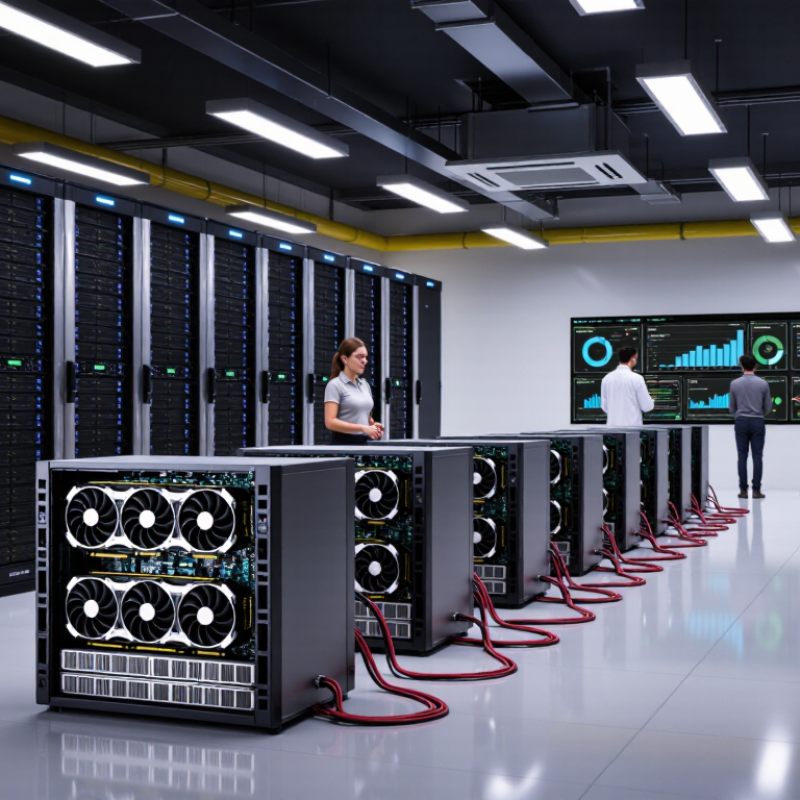
An AI inference server is a computing system that runs trained AI models and produces results from new data. Unlike training systems, it focuses on fast, repeated responses. A camera stream may require object detection every second. A customer service platform may process thousands of text requests daily.
Its role connects software intelligence with real business activity. The server receives input, applies a trained model, and returns a prediction, recommendation, or generated response. Strong systems manage latency, memory, security, and workload changes. In practice, buyers should examine processor design, accelerator support, storage speed, network capacity, and cooling requirements. A powerful specification sheet does not always guarantee stable performance. That assumption is often wrong.
Tips: Test with your real model and typical data sizes. Measure response time, throughput, power use, and failure recovery. Ask for documented benchmark methods, service terms, firmware updates, and technical support coverage. Check whether the server can scale from a small pilot to a larger deployment. Keep sensitive data protected during testing. Small delays become expensive at high request volumes. Also, confirm compatibility with your existing software stack, because integration problems may appear after installation. One practical lesson deserves attention: the fastest server in a laboratory may perform differently in a crowded production room. Temperature, network traffic, and imperfect data can change the result.
AI inference server performance depends less on peak accelerator speed than on balanced data movement. In production tests, memory bandwidth often limits transformer workloads before compute capacity does. High-bandwidth memory keeps model weights close to processing cores, reducing costly transfers. Fast interconnects also help when one model spans several accelerators.
Quantization reduces weight precision from floating point to eight or four bits. This lowers memory use and can improve throughput, but accuracy may drift on rare requests. Calibration with representative, multilingual data is essential.
Dynamic batching combines nearby requests, while continuous batching keeps accelerators busy. Yet oversized batches can damage interactive latency. A practical deployment tracks both throughput and p95 response time.
The software path matters just as much. Optimized kernels, graph compilation, and key-value cache management can remove milliseconds from every response. Container isolation, redundant power, and error-correcting memory support dependable service.
Telemetry should expose queue depth, token rate, temperature, and failed requests. A benchmark can mislead. Real traffic is messier, especially during sudden demand. Engineers should retest after model updates, because a small tokenizer change can alter memory pressure and operating costs.
Comparing global AI inference server manufacturers requires more than reading peak TOPS. Buyers should examine p95 latency, tokens per second, memory bandwidth, and accuracy after quantization. MLCommons’ MLPerf Inference results show major performance differences across workloads and accelerator configurations. Therefore, request test data using your model, batch size, and target precision.
Cost also needs a wider view. The Stanford AI Index 2024 reported that GPT-3.5-level inference costs fell from about $20 to $0.07 per million tokens between November 2022 and October 2023. This sharp decline makes hardware efficiency harder to judge by purchase price alone. Measure power per request, cooling needs, software licensing, maintenance, and expected utilization. The International Energy Agency projects data-center electricity demand could more than double by 2026. Energy efficiency is becoming a procurement requirement, not a bonus.
Tips: Ask manufacturers for reproducible benchmarks, not selected screenshots. Check independent test conditions. Review supply lead times, regional service coverage, spare-part policies, security controls, and firmware support. A lower-cost server may perform well in a laboratory but disappoint under mixed workloads. That happens. Leave room for uncertainty, because real traffic is rarely clean. Evaluate three-year total cost and run a small pilot before committing to volume.
Global buyers evaluating the top 10 AI inference server manufacturers should examine performance beyond headline accelerator counts. TrendForce forecast AI server shipments to grow by about 28% in 2025, increasing pressure on supply, support, and delivery schedules. A dependable manufacturer should provide validated accelerator options, high-bandwidth memory, fast networking, and clear firmware policies. Rack-level testing matters. So does regional service coverage.
Inference economics are changing quickly. The Stanford AI Index 2025 reported that the cost of querying a model with GPT-3.5-level performance fell more than 280-fold between November 2022 and October 2024. This favors servers with strong throughput per watt, flexible model support, and efficient cooling. The International Energy Agency expects data-center electricity consumption to more than double by 2030, reaching roughly 945 terawatt-hours. Buyers should request measured power data, not only theoretical specifications.
A practical comparison should include latency at real batch sizes, uptime evidence, spare-part access, and software compatibility. Ask for results using your workloads. Public benchmarks can mislead. Five-year operating cost may outweigh the purchase price, especially where electricity is expensive. Some manufacturers still provide incomplete thermal or service data, which deserves scrutiny. Procurement teams should also verify export rules, warranty limits, and local installation expertise before signing large contracts.
This vendor-neutral chart compares ten numerical formats commonly used in AI inference workloads by their storage width in bits. Lower-bit formats generally reduce memory traffic and can improve inference efficiency, while higher-precision formats provide greater numerical range and accuracy.
Buying an AI inference server starts with workload evidence, not attractive specifications. Define model size, request volume, latency targets, and acceptable accuracy loss. Measure real traffic patterns, including evening spikes and uneven regional demand. A server that excels in laboratory tests may struggle with simultaneous users. Test before committing.
Compare accelerator memory, system RAM, storage speed, network bandwidth, and expansion capacity. Memory limits often determine whether a model runs smoothly or relies on slower data movement. Check support for your preferred frameworks, quantization methods, containers, and orchestration tools. Compatibility saves weeks of engineering work. It also reduces deployment risk.
Power and cooling deserve practical attention. A dense rack may need stronger airflow, upgraded circuits, and careful noise planning. Calculate electricity, maintenance, licensing, replacement parts, and operator time over three years. Local service coverage matters when a failed component stops revenue-generating workloads. Request documented response times and spare-part policies. Security should include encrypted storage, controlled access, audit logs, and timely firmware updates. Avoid purchasing only for peak performance. Underused hardware becomes an expensive reminder of optimistic forecasting. Our own evaluations should remain skeptical, because benchmark conditions rarely match production behavior. Start with a pilot, monitor latency and error rates, then scale in measured stages. Even a well-designed plan may need revision.
| Rank | Manufacturer Profile | Typical Server Form Factor | Accelerator Capacity | GPU/Accelerator Interface | System Memory Range | Networking Options | Approx. Power Range | Best-Fit Inference Workload | Deployment Strength | Key Purchasing Consideration |
|---|---|---|---|---|---|---|---|---|---|---|
| 1 | Manufacturer Profile A | 4U GPU server | 4 to 8 double-width accelerators | PCIe Gen4/Gen5, optional high-speed fabric | 256 GB to 2 TB DDR4/DDR5 ECC | Dual 25/100GbE; optional 200GbE or InfiniBand | 2.5 to 8.0 kW | Large language models, computer vision, batch inference | Private cloud and centralized data centers | Confirm rack power, cooling capacity, and accelerator availability. |
| 2 | Manufacturer Profile B | 2U GPU server | 2 to 4 double-width accelerators | PCIe Gen4/Gen5 | 128 GB to 1 TB DDR5 ECC | Dual 25/100GbE | 1.5 to 4.5 kW | Real-time recommendation, speech, and vision services | Enterprise virtualization and Kubernetes clusters | Evaluate latency under sustained load rather than peak benchmark speed. |
| 3 | Manufacturer Profile C | 1U accelerator server | 1 to 2 single-width accelerators | PCIe Gen4/Gen5 | 64 GB to 512 GB DDR5 ECC | Dual 10/25GbE | 600 W to 1.8 kW | Low-latency API inference and edge-adjacent workloads | Space-constrained colocation facilities | Check accelerator height, airflow direction, and acoustic limits. |
| 4 | Manufacturer Profile D | 4U liquid-assisted server | 4 to 8 high-power accelerators | PCIe Gen5 and high-bandwidth interconnect options | 512 GB to 4 TB DDR5 ECC | 100/200/400GbE or InfiniBand | 4.0 to 10.0 kW | High-throughput generative AI and multi-user serving | Hyperscale and high-density data centers | Budget for coolant distribution, leak detection, and service training. |
| 5 | Manufacturer Profile E | 2U storage-integrated server | 2 to 4 accelerators | PCIe Gen4/Gen5 | 256 GB to 1 TB DDR5 ECC | Dual 25/100GbE; NVMe-oF capable designs | 1.8 to 4.8 kW | Retrieval-augmented generation and media analytics | Data-intensive enterprise applications | Compare local NVMe endurance, RAID options, and data-protection features. |
| 6 | Manufacturer Profile F | 2U multi-node server | 2 to 4 independent accelerator nodes | PCIe Gen4/Gen5 per node | 128 GB to 512 GB per node | 10/25/100GbE | 1.2 to 3.5 kW | Microservices, vision pipelines, and independent model endpoints | Mixed workloads requiring granular scaling | Verify node-level failure isolation and replacement procedures. |
| 7 | Manufacturer Profile G | 1U edge-oriented server | 1 to 2 compact accelerators | PCIe Gen4 or low-profile accelerator slots | 64 GB to 256 GB DDR4/DDR5 ECC | Dual 10/25GbE; optional 5G or industrial uplink | 350 W to 1.2 kW | Retail analytics, factory inspection, and smart-city inference | Remote and distributed locations | Prioritize temperature range, remote management, and field-serviceability. |
| 8 | Manufacturer Profile H | 4U modular expansion server | 4 to 8 accelerators with modular trays | PCIe Gen5 and optional accelerator fabric | 512 GB to 2 TB DDR5 ECC | 100/200GbE; optional 400GbE uplink | 3.0 to 8.5 kW | Model serving with future accelerator expansion | Organizations planning phased capacity growth | Review upgrade paths, firmware compatibility, and spare-part lead times. |
| 9 | Manufacturer Profile I | 2U balanced CPU-accelerator server | 2 to 4 accelerators | PCIe Gen4/Gen5 with high-core-count CPU support | 256 GB to 2 TB DDR5 ECC | Dual 25/100GbE | 1.6 to 5.0 kW | Pre-processing-heavy inference and multi-modal applications | General-purpose enterprise AI platforms | Benchmark CPU preprocessing, memory bandwidth, and end-to-end latency. |
| 10 | Manufacturer Profile J | 4U high-memory server | 4 to 8 accelerators | PCIe Gen4/Gen5; optional peer-to-peer access | 1 TB to 4 TB DDR5 ECC | 100/200GbE or InfiniBand | 3.5 to 9.0 kW | Large-model serving, long-context workloads, and high concurrency | Research institutions and enterprise AI factories | Validate memory population rules, NUMA topology, and model-fit capacity. |
Memory bandwidth often limits transformer workloads before accelerator compute capacity does. High-bandwidth memory keeps model weights near processing cores. Peak speed can mislead.
Quantization changes weights from floating-point values to eight or four bits. It reduces memory use and may improve throughput. Accuracy can drift on rare requests. Test multilingual samples before deployment.
Dynamic batching combines nearby requests. Continuous batching keeps accelerators busy as requests arrive. Oversized batches can increase interactive latency. Track throughput and p95 response time together.
Optimized kernels can remove repeated computation. Graph compilation reduces execution overhead. Key-value cache management can save milliseconds per response. Small gains accumulate.
Request p95 latency, tokens per second, memory bandwidth, and accuracy after quantization. Use your model and target batch size. Request measured power data, not only theoretical specifications.
A benchmark may use cleaner traffic than production. Real requests vary in length, timing, and model features. Sudden demand changes everything. Retest under mixed workloads.
Include purchase price, electricity, cooling, software licenses, maintenance, and utilization. Power per request is especially useful. A cheaper server may cost more over five years.
Ask for reproducible tests and independent conditions. Review delivery times, spare parts, firmware support, security controls, and regional service. Start small. Run a pilot before volume purchasing.
AI inference servers are specialized systems designed to run trained artificial intelligence models and deliver fast, reliable predictions for applications such as automation, analytics, language processing, and computer vision. Their performance depends on key technologies including powerful processors, accelerator hardware, memory capacity, high-speed networking, optimized software frameworks, cooling systems, and efficient power management. For global buyers, comparing an ai inference server manufacturer requires careful evaluation of computing performance, scalability, system reliability, security features, compatibility, technical support, customization options, and total ownership costs.
This overview introduces ten leading categories of AI inference server manufacturers without focusing on specific brands, helping buyers understand how different suppliers address enterprise, industrial, cloud, and edge computing needs. It also highlights important purchasing and deployment considerations, including workload analysis, model size, latency requirements, data-center conditions, integration with existing infrastructure, maintenance plans, upgrade flexibility, energy efficiency, and compliance expectations. A well-planned selection process can help organizations achieve stable AI performance while controlling operational costs and preparing their infrastructure for future model growth.
